Scaling TypeScript: Project References, Composite Builds, and Fast CI
How large TypeScript codebases stay fast: project references, composite builds, incremental compilation, and clean boundaries.
On this page
What you’ll learn
- Why big repos get slow and how TS project references help
- What
compositereally means - A practical setup for monorepos or multi-package apps
30‑second interview answer
Project references let TypeScript treat a codebase as multiple smaller projects with explicit dependencies. Each project can be built incrementally and cached, which speeds up local builds and CI. The key pieces are references, composite: true, and emitting declarations so dependent projects can type-check against outputs.
The problem: one giant TS program
In a large repo, a single tsc -p tsconfig.json can become slow because TS re-checks everything.
Project references solve this by:
- Splitting into smaller graphs
- Caching build info per project
- Allowing incremental rebuilds
Minimal example
Root tsconfig
{
  "files": [],
  "references": [
    { "path": "./packages/ui" },
    { "path": "./packages/api" }
  ]
}
Package tsconfig (packages/ui/tsconfig.json)
{
  "compilerOptions": {
    "composite": true,
    "declaration": true,
    "declarationMap": true,
    "outDir": "dist",
    "tsBuildInfoFile": "dist/.tsbuildinfo"
  },
  "include": ["src"]
}
Now TS can build the graph:
tsc -bWhat composite implies
- TS will enforce certain constraints that make builds reliable
- It enables build info generation for incremental builds
Boundary rules (how you keep it healthy)
- Each package exposes a public API (index.ts)
- Dependent packages import only from public API
- Avoid circular dependencies between referenced projects
Production rule of thumb
- Use project references when you have:
- monorepos
- multiple packages
- slow CI from large TS builds
If your repo is small, don’t add this complexity.
Interview questions
-
Q: What’s the benefit of project references?
- A: Faster builds via incremental compilation and cached outputs per project.
-
Q: What is
tsc -b?- A: Build mode that builds a graph of referenced projects in the correct order.
Quick recap
- References split your code into buildable chunks.
composite+tsc -benables fast incremental builds.- Enforce boundaries to avoid dependency spaghetti.
Looking for structured, offline interview prep?
Free online lessons • Portable Amazon Kindle / Paperback

Frontend Interview Guide (2025 Edition)
By Rajesh Dhiman
Comprehensive preparation covering React internals, Web Performance, CSS architecture, and system design questions.
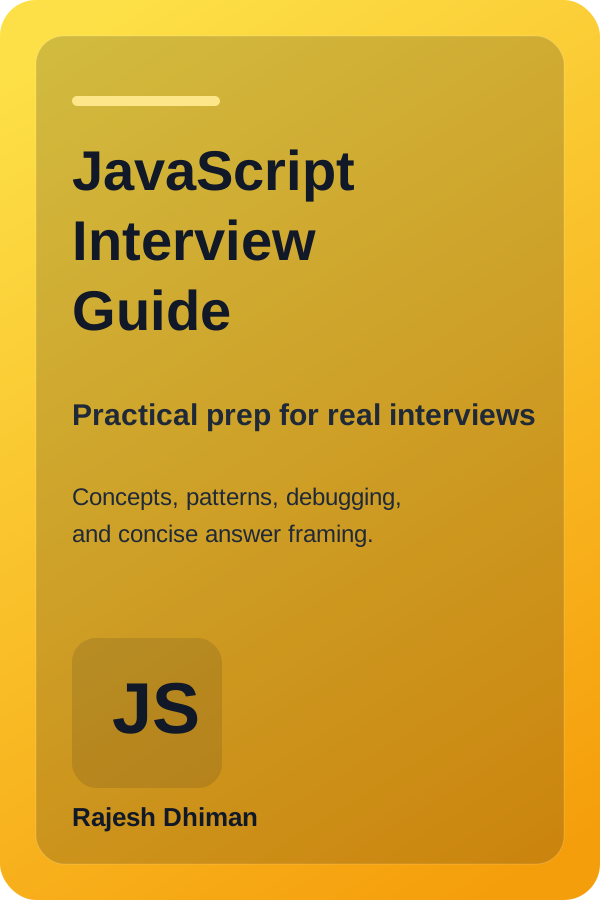
JavaScript Interview Guide
By Rajesh Dhiman
Deep dive into the Event Loop, microtask draining, closures, prototypal inheritance, and asynchronous execution patterns.
Note: All lessons on Frontend Interview remain completely free to read online. As an Amazon Associate, we may earn from qualifying purchases.
Written by Rajesh Dhiman
Authored by Rajesh Dhiman and engineered at Eunix Tech. Focused on deep-dive frontend engineering, JavaScript runtime internals, React architecture, and web performance.