TypeScript: types vs interfaces (When to Use Which)
A deep, interview-ready guide to TypeScript types vs interfaces: extension, unions, intersections, declaration merging, and practical patterns for real codebases.
On this page
Types vs interfaces is one of the most common TypeScript interview questions.
The truth: both can model object shapes. But they differ in a few important ways that matter in real projects.
1) The shared basics
Both can describe object shapes:
type UserType = {
  id: string;
  name: string;
};

interface UserInterface {
  id: string;
  name: string;
}
So the interview question is really about the differences.
2) Key difference: declaration merging
Interfaces can merge
interface Config {
  timeout: number;
}

interface Config {
  baseUrl: string;
}

// Config is now { timeout: number; baseUrl: string }
This is useful for:
- augmenting library types
- extending global types
For a complete working example, compiler errors, and a practice question, continue with TypeScript declaration merging and module augmentation.
Types cannot merge
If you redeclare a type, it’s an error.
3) Unions and primitives
Types are more flexible
Types can represent unions, primitives, tuples:
type Id = string | number;
type Status = 'idle' | 'loading' | 'success' | 'error';

type Point = [number, number];
Interfaces are mainly for object shapes.
4) Extending / composition
Interfaces extend nicely
interface Base {
  id: string;
}

interface User extends Base {
  name: string;
}
Types use intersections
type Base = { id: string };
type User = Base & { name: string };
Both are fine. In practice:
- interfaces read cleaner for object models
- types are great when you need unions + composition
5) “Prefer interface for public APIs” — why?
Some teams prefer interface for object models because:
- better error messages (often)
- easier to extend
- supports declaration merging
But it’s not a hard rule.
6) Common real-world patterns
Pattern A: Use interface for data models
interface User {
  id: string;
  email: string;
}
Pattern B: Use types for complex derived types
type ApiResult<T> =
  | { ok: true; data: T }
  | { ok: false; error: string };
7) Interview Q&A
Q: When would you use interface over type?
- For object shapes that you expect to extend/merge (public APIs, library augmentation).
Q: When would you use type over interface?
- For unions, primitives, tuples, mapped/conditional types.
Q: Can interfaces do unions?
- Not directly.
Summary
- Both work for object shapes.
- Interface supports declaration merging and reads well for models.
- Type is more general (unions, primitives, tuples, advanced composition).
- In real code: interface for models, type for complex/derived types is a solid default.
Looking for structured, offline interview prep?
Free online lessons • Portable Amazon Kindle / Paperback

Frontend Interview Guide (2025 Edition)
By Rajesh Dhiman
Comprehensive preparation covering React internals, Web Performance, CSS architecture, and system design questions.
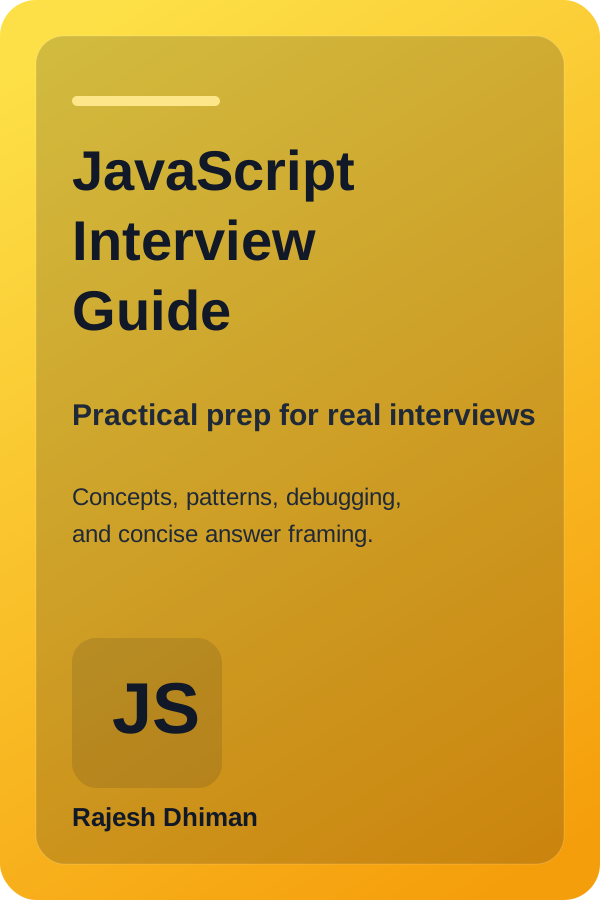
JavaScript Interview Guide
By Rajesh Dhiman
Deep dive into the Event Loop, microtask draining, closures, prototypal inheritance, and asynchronous execution patterns.
Note: All lessons on Frontend Interview remain completely free to read online. As an Amazon Associate, we may earn from qualifying purchases.
Written by Rajesh Dhiman
Authored by Rajesh Dhiman and engineered at Eunix Tech. Focused on deep-dive frontend engineering, JavaScript runtime internals, React architecture, and web performance.