Caching & CDNs: HTTP Caching That Actually Works
A practical guide to cache-control, ETag, immutable assets, and CDN strategy to reduce TTFB and speed up repeat visits.
On this page
What you’ll learn
- What
Cache-Controldirectives really do - How to cache static assets “forever” safely
- How CDNs reduce TTFB and improve LCP
30‑second interview answer
HTTP caching is controlled mainly by Cache-Control. For versioned static assets (like app.abc123.js) you can use public, max-age=31536000, immutable. For HTML/documents you usually cache short or use validation (ETag). A CDN improves performance by serving content closer to users and reducing TTFB. The key is: long-cache immutable assets, carefully cache HTML, and avoid accidental stale dynamic content.
Two categories of content
1) Versioned static assets
Examples:
- JS/CSS bundles with hashes
- images with hashed filenames
These are safe to cache for a year.
2) Documents / dynamic responses
Examples:
- HTML
- API responses
These need shorter caching or validation.
The most useful headers
Cache-Control
Common patterns:
- Static hashed assets:
public, max-age=31536000, immutable
- HTML:
public, max-age=0, must-revalidate(forces validation)
ETag
Allows revalidation:
- Client asks: “do you still have the same version?”
- Server answers 304 (no body) if unchanged
CDN mental model
A CDN is a distributed cache.
It helps by:
- reducing round trip latency (TTFB)
- offloading origin
But it can hurt if you cache personalized content.
Common mistakes
- Caching HTML for too long (users see stale pages)
- Not hashing asset filenames, then using long cache (can’t roll back safely)
- Forgetting
Varyheaders for content negotiation
Production rule of thumb
- Hash static assets → cache long + immutable.
- Cache HTML cautiously → prefer revalidation.
- Use a CDN for global users.
Quick recap
- Caching strategy depends on content type.
- Long-cache immutable assets, validate documents.
- CDNs reduce TTFB and improve real-user speed.
Performance checklist (copy/paste)
- Hashed static assets:
max-age=31536000, immutable - HTML/documents: cache short or revalidate (ETag)
- Verify CDN is not caching personalized responses
- Confirm caching behavior in DevTools (from disk/memory cache, 304s)
Looking for structured, offline interview prep?
Free online lessons • Portable Amazon Kindle / Paperback
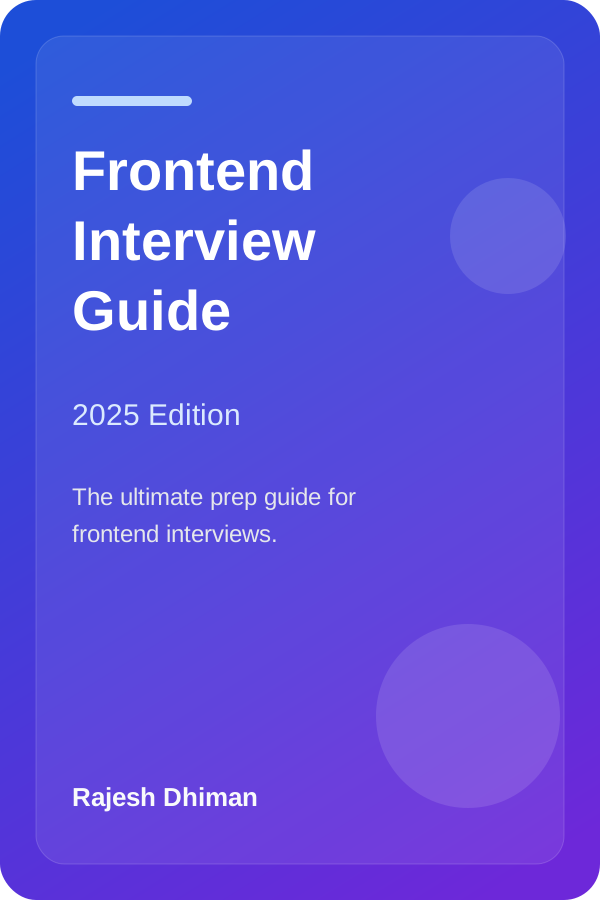
Frontend Interview Guide (2025 Edition)
By Rajesh Dhiman
Comprehensive preparation covering React internals, Web Performance, CSS architecture, and system design questions.

JavaScript Interview Guide
By Rajesh Dhiman
Deep dive into the Event Loop, microtask draining, closures, prototypal inheritance, and asynchronous execution patterns.
Note: All lessons on Frontend Interview remain completely free to read online. As an Amazon Associate, we may earn from qualifying purchases.
Written by Rajesh Dhiman
Authored by Rajesh Dhiman and engineered at Eunix Tech. Focused on deep-dive frontend engineering, JavaScript runtime internals, React architecture, and web performance.